A comprehensive guide to the decentralized financial landscape
Decentralized Finance (DeFi) represents a paradigm shift in how we think about and interact with financial systems. Unlike traditional centralized finance where institutions like banks act as intermediaries, DeFi leverages blockchain technology to create open, permissionless, and transparent financial services.
Web3, the next evolution of the internet, provides the technological foundation for DeFi, enabling truly peer-to-peer interactions without relying on trusted third parties.
This guide will take you through the complete DeFi ecosystem, explaining each component and how they work together to create a new financial paradigm.
Data source: DeFi Pulse, 2023
Think of DeFi as a digital financial city. Each component is like a different type of building or service in this city:
The foundation of our city - blockchain networks, smart contracts, and validators that ensure everything runs properly.
Like news stations that tell everyone the current prices - oracles ensure everyone is trading at fair market rates.
Where financial services happen - AMMs for trading, lending protocols for borrowing, and staking protocols for investing.
Like airports connecting cities - cross-chain bridges let assets move between different blockchain networks.
The customer service area - interfaces that make complex operations user-friendly and accessible.
The security system - monitors for problems, protects assets, and ensures safe operation.
Anyone with an internet connection can access DeFi services without requiring approval from centralized gatekeepers.
All transactions are recorded on public blockchains, allowing anyone to verify and audit the system's operations.
Smart contracts enable automatic execution of financial agreements without human intermediaries.
DeFi protocols can be combined like "money legos" to create complex financial products and services.
Services are available globally, breaking down traditional geographic barriers to financial inclusion.
Users maintain control of their assets without needing to trust a centralized institution to safeguard them.
The foundation upon which the entire DeFi ecosystem is built
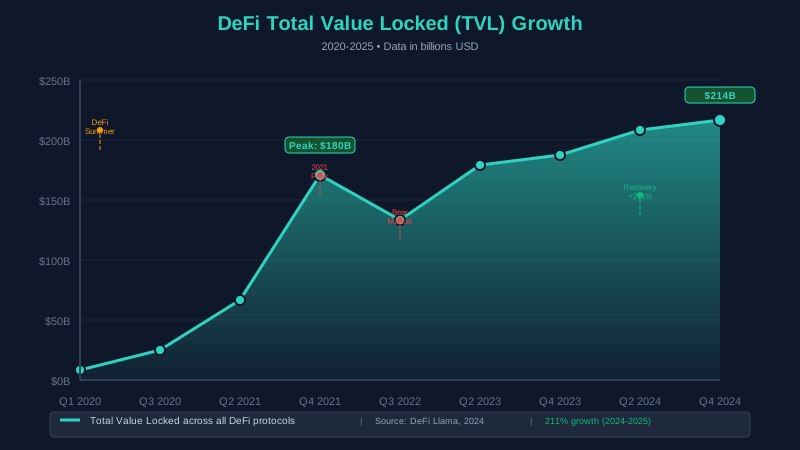
Blockchain networks are the foundational infrastructure of the DeFi ecosystem, with total value locked reaching $214 billion (211% growth in 2024-2025), providing distributed ledger technology that enables secure, transparent transactions without intermediaries.
Still the largest DeFi ecosystem with advanced features including ERC-4337 account abstraction (1.9M deployed wallets) and upcoming EIP-7702 enabling temporary smart contract delegation.
Explosive growth from $200M to over $2B TVL showcasing Move programming language's power with parallel execution and resource-oriented security.
Institutional-grade scalability with 30,000+ TPS using Move language and advanced parallel execution, preventing common smart contract vulnerabilities.
Coinbase's L2 solution bridging Web2 and Web3 with integration to 110M users, featuring optimized transaction costs below $0.0001.
Snow protocol family achieves sub-second finality through novel sub-sampling approaches, enabling sophisticated cross-chain coordination.
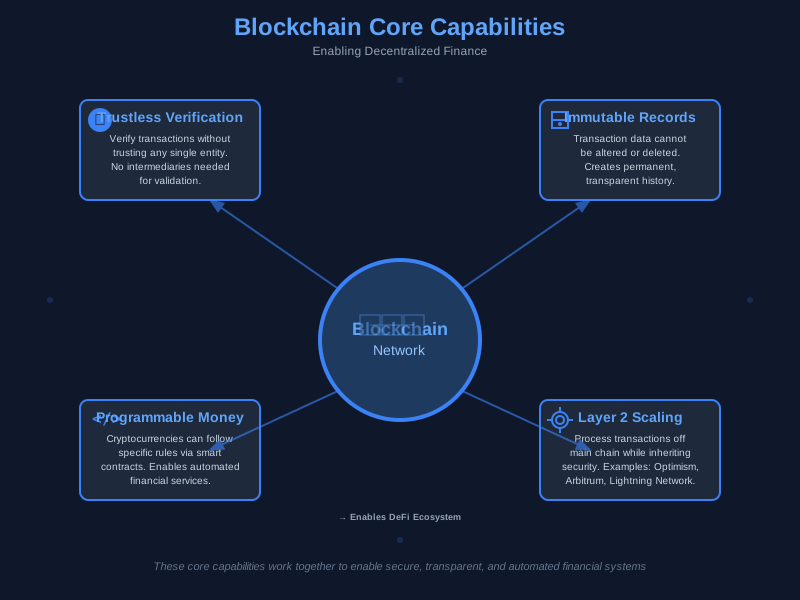
Blockchains provide several critical capabilities that make DeFi possible:
Network participants can verify transactions without trusting any single entity. This eliminates the need for intermediaries like banks to validate transactions.
Once recorded, transaction data cannot be altered or deleted, creating a permanent and transparent financial history that can be audited by anyone.
Cryptocurrencies on these networks can be programmed to follow specific rules or behaviors through smart contracts, enabling automated financial services.
Technologies built on top of base blockchains that improve scalability by processing transactions off the main chain while inheriting its security properties.
Smart contracts are self-executing pieces of code that run on blockchains. They automatically enforce and execute the terms of an agreement when predetermined conditions are met.
In DeFi, smart contracts enable:
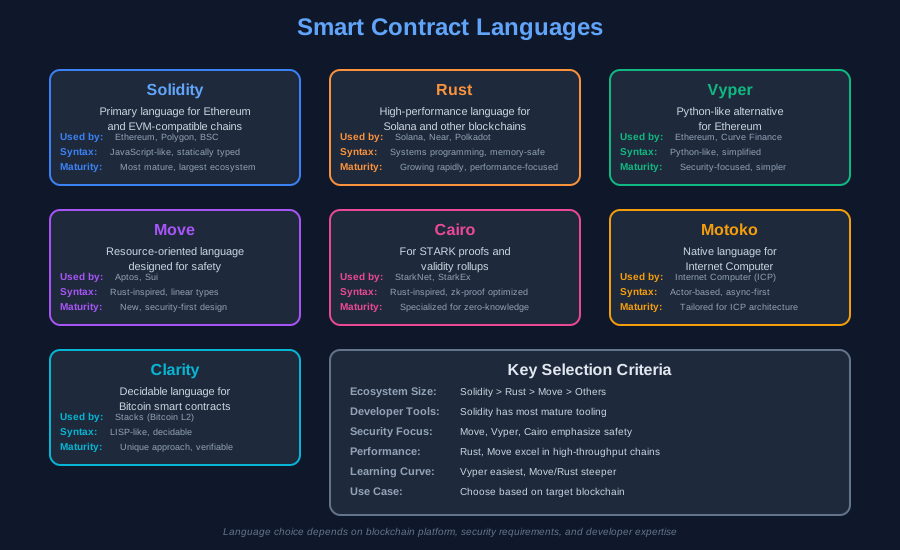
Primary language for Ethereum and EVM-compatible chains
Used for Solana and other high-performance blockchains
Python-like alternative for Ethereum development
Designed for safety and security in Sui and Aptos
Rust-inspired language for STARK proofs on StarkNet
Native language for Internet Computer Protocol (ICP)
Predictable language for Stacks (Bitcoin sidechain)
Efficient language for TON Blockchain development
// Simplified Automated Market Maker (AMM) Smart Contract
contract SimpleAMM {
// Token reserves
uint256 public reserveA;
uint256 public reserveB;
// Add liquidity to the pool
function addLiquidity(uint256 amountA, uint256 amountB) external {
// Transfer tokens from user
// Update reserves
reserveA += amountA;
reserveB += amountB;
// Mint LP tokens to provider
}
// Swap tokenA for tokenB
function swapAForB(uint256 amountIn) external returns (uint256) {
// Calculate price based on constant product formula
// x * y = k
uint256 amountOut = (reserveB * amountIn) / (reserveA + amountIn);
// Update reserves
reserveA += amountIn;
reserveB -= amountOut;
// Transfer tokens
return amountOut;
}
// Other functions: remove liquidity, swapBForA, etc.
}
This simplified example shows how an Automated Market Maker (AMM) maintains a constant product formula (x * y = k) to determine exchange rates without order books.
Validators are network participants responsible for verifying transactions and maintaining the blockchain's security. They operate nodes that participate in the consensus process.
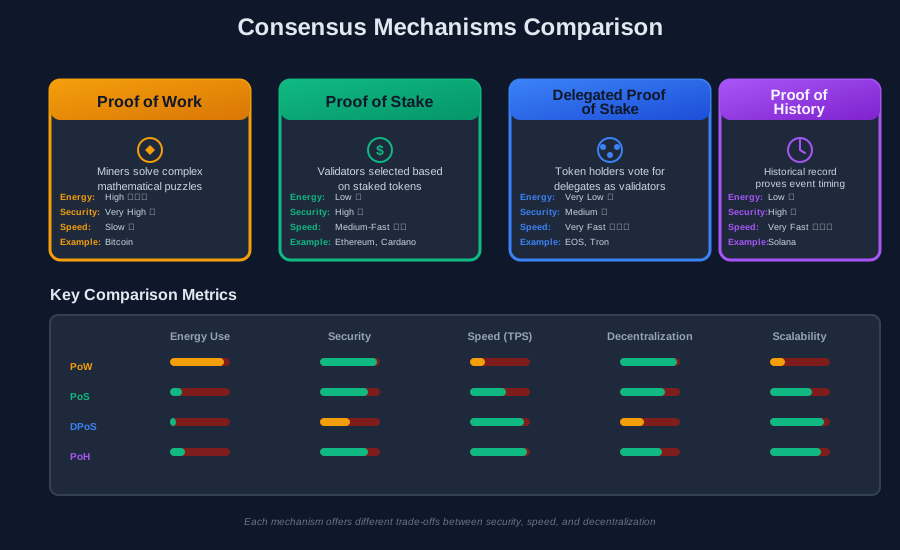
Consensus mechanisms are the protocols that ensure all nodes in the network agree on the current state of the blockchain, preventing double-spending and other attacks.
Used by Bitcoin. Secure but energy-intensive.
Used by Ethereum 2.0, Cardano, and others. Energy-efficient alternative to PoW.
Used by EOS and Tron. Offers high transaction throughput.
Used by Solana. Enables high transaction speeds.
Validators secure billions of dollars in DeFi protocols by maintaining the integrity of the underlying blockchain.
They process and validate all DeFi transactions, from simple token transfers to complex smart contract interactions.
Validators often participate in governance decisions for the blockchain, influencing the future direction of the network.
Through staking rewards and penalties, validators have economic incentives aligned with the health of the network.
The systems that provide external data to blockchain networks
Oracle infrastructure has evolved beyond simple price feeds, with next-generation solutions supporting 70+ blockchains and achieving zero mispricing incidents. These systems now capture Oracle Extractable Value (OEV) and integrate AI-powered data validation.
Now supports 46+ blockchains with enterprise-grade security and cross-chain interoperability. CCIP enables secure cross-chain communication with built-in fraud detection.
Provides an optimistic oracle system where data is assumed correct unless disputed, reducing gas costs for simple oracle requests.
Modular architecture supporting 70+ blockchains with zero mispricing incidents. Features real-time anomaly detection and OEV capture mechanisms.
Schnorr signatures reduce gas costs by 60-68% while providing fraud proofs and enhanced security. Features attestation services for institutional adoption.
Focused on first-party oracles where API providers run their own nodes, reducing the middleman risk and improving data quality.
Designed for high-performance blockchains like Solana, delivering financial market data with sub-second latency.
Without oracles, smart contracts would be limited to data already on the blockchain, making most DeFi applications impossible.
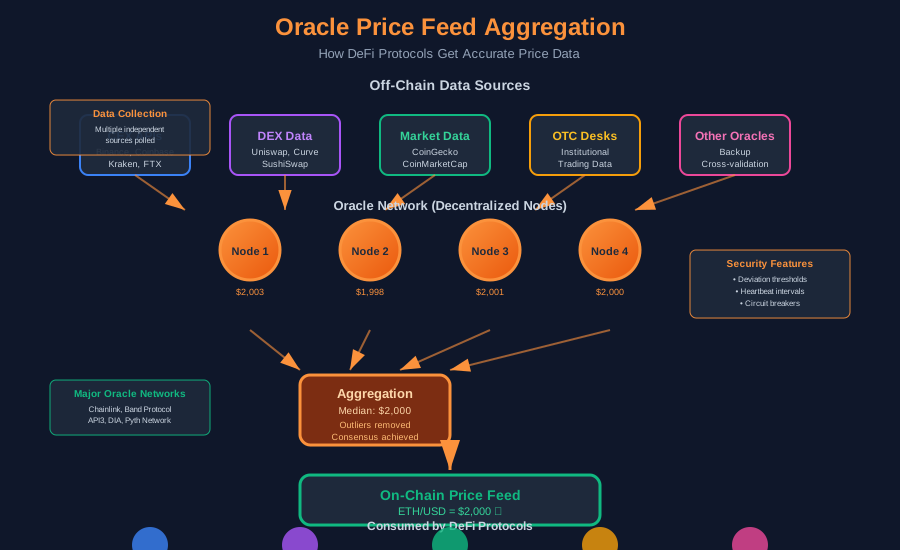
Blockchains are deterministic systems that cannot access external data directly. This creates the "oracle problem" - how to reliably bring off-chain data on-chain without compromising decentralization or security.
Oracle nodes collect data from multiple sources (exchanges, data providers, APIs) to ensure reliability.
Data points are aggregated using statistical methods to remove outliers and ensure accuracy. This process makes oracle attacks more difficult and costly.
The validated data is submitted to a smart contract on the blockchain, where it becomes available for other contracts to use.
DeFi protocols reference oracle contracts to obtain the latest price data, using it for critical operations like collateral valuation, liquidation triggers, and exchange rates.
The most common type of oracle data in DeFi, providing cryptocurrency, forex, commodities, and stock price information.
Used by: Lending platforms to value collateral, DEXes for reference prices, derivatives platforms for settlement prices.
Verifiable random numbers that can't be predicted or manipulated, crucial for fair selection processes and games.
Used by: NFT drops, gaming applications, random selection mechanisms in governance or distribution systems.
Temperature, rainfall, and other weather metrics used for parametric insurance and weather derivatives.
Used by: Crop insurance protocols, weather-based financial products, climate-related DAOs.
Real-world sports scores, election results, and other event outcomes for prediction markets and betting platforms.
Used by: Prediction markets, sports betting platforms, event-triggered financial products.
Real-time information about network transaction fees, allowing protocols to optimize transaction timing and fee settings.
Used by: MEV protection systems, gas optimization protocols, cross-chain bridges.
Inflation rates, employment figures, and other macroeconomic indicators for synthetic assets and indices.
Used by: Synthetic asset platforms, algorithmic stablecoins, macro-trading strategies.
Price discovery is the process by which asset prices are determined through market interactions. In DeFi, this happens through various mechanisms that balance supply and demand in a decentralized way.
Used by DEXes like dYdX and Serum. Matches buy and sell orders from traders, similar to traditional exchanges.
Pros: Efficient price discovery, familiar to traditional traders
Cons: Higher gas costs on Ethereum, requires more liquidity
Used by Uniswap and Curve. Sets prices algorithmically based on token ratios in liquidity pools.
Pros: Always available liquidity, simpler user experience
Cons: Slippage for large trades, impermanent loss for providers
Used by Gnosis Protocol. Collects orders over a period and finds the optimum clearing price.
Pros: Protection against frontrunning, better prices for large orders
Cons: Slower execution, less immediate liquidity
Used by token launch platforms. Price is determined by a mathematical formula based on token supply.
Pros: Predictable price changes, automatic liquidity
Cons: Can be manipulated, potentially high volatility
Data must accurately reflect real-world conditions. Inaccurate data can lead to incorrect contract execution and financial losses.
Data must be consistently available when needed. Unavailable oracles can prevent critical contract operations, causing system failures.
Data must be tamper-resistant. Compromised oracles can be manipulated to profit from predictable contract behaviors.
Like the blockchain trilemma, oracle solutions must balance these three priorities. Different oracle designs make different tradeoffs between correctness, availability, and security.
The financial services and applications built on top of the infrastructure layer
Advanced AMM models have revolutionized capital efficiency, with concentrated liquidity now accounting for 85% of Uniswap volume, enabling LPs to earn up to 320% more fees. These systems achieve 100x capital efficiency improvements while introducing calculated risk-reward profiles.
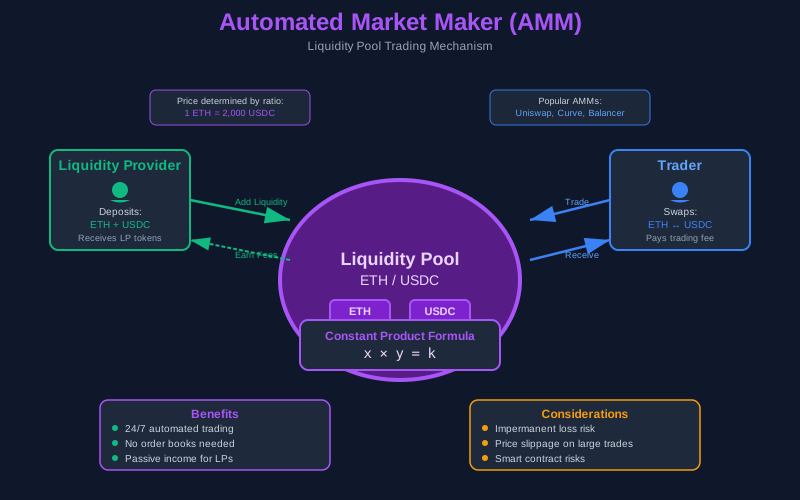
Users provide pairs of tokens to liquidity pools, receiving LP tokens in return that represent their share of the pool.
Most AMMs use the constant product formula (x * y = k), where x and y are the amounts of each token in the pool and k is a constant.
When a user trades, they add one token to the pool and remove another, changing the ratio and therefore the price.
Trading fees are distributed to liquidity providers as incentives, typically ranging from 0.05% to 1% of trade volume.
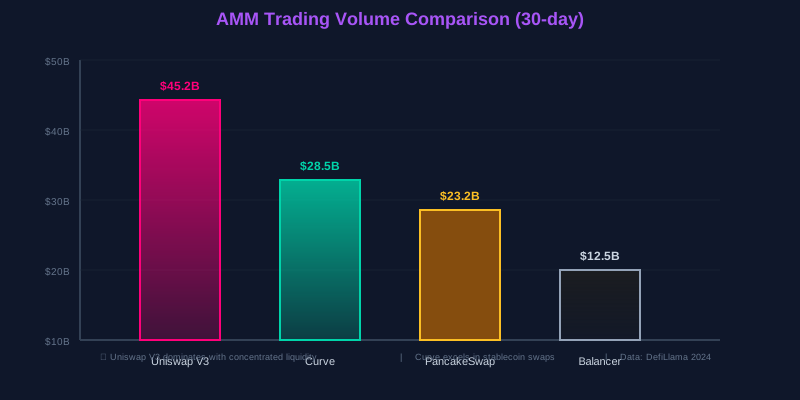
The pioneer AMM with a simple x*y=k formula. V3 introduced concentrated liquidity, allowing providers to allocate capital within specific price ranges.
Specialized for stablecoin and similar-value token swaps. Uses a different formula optimized for minimal slippage between assets of similar value.
A fork of Uniswap that added additional features like yield farming and staking rewards through its SUSHI token.
Supports multi-token pools (up to 8 tokens) with customizable weights, enabling more complex trading strategies and portfolio management.
As AMMs have evolved, they've introduced new features to address early limitations while facing ongoing challenges:
Enables LPs to provide liquidity within specific price ranges, increasing capital efficiency (Uniswap V3, Algebra).
Adjusts trading fees based on market volatility and pool conditions (Bancor V3, Balancer V2).
Adds liquidity right before a large trade and removes it immediately after to capture fees with minimal exposure.
Liquidity positions that actively rebalance based on market conditions (Bancor V3, Osmosis).
Support for pools with more than two assets, enabling complex trading strategies and reduced slippage (Balancer, Curve).
Smart rebalancing mechanisms that automatically adjust portfolio weights based on market conditions and user preferences.
Loss compared to holding when asset prices change. Particularly impacts volatile token pairs.
Price impact when trading large amounts, resulting in worse execution than expected.
Value extracted through frontrunning and sandwich attacks, hurting trader execution.
Traditional AMMs require large amounts of idle capital to maintain liquidity.
Lending primitives are expanding beyond overcollateralization with Morpho's permissionless isolated markets and RWA-backed lending. The $33B overcollateralized market coexists with emerging $300M undercollateralized lending through platforms like Goldfinch and Maple.
The most common model in DeFi. Borrowers must provide collateral worth more than the borrowed amount (typically 125-175%).
Examples: Aave, Compound, Maker
Uncollateralized loans that must be borrowed and repaid within a single blockchain transaction. Used for arbitrage, liquidations, and more.
Examples: Aave, dYdX, Euler
Directly matches individual lenders with borrowers, often with negotiable terms. Less common in DeFi but growing.
Examples: Maple Finance, TrueFi
Emerging model that allows borrowing more than collateral value, often based on reputation or off-chain credentials.
Examples: Goldfinch, Centrifuge
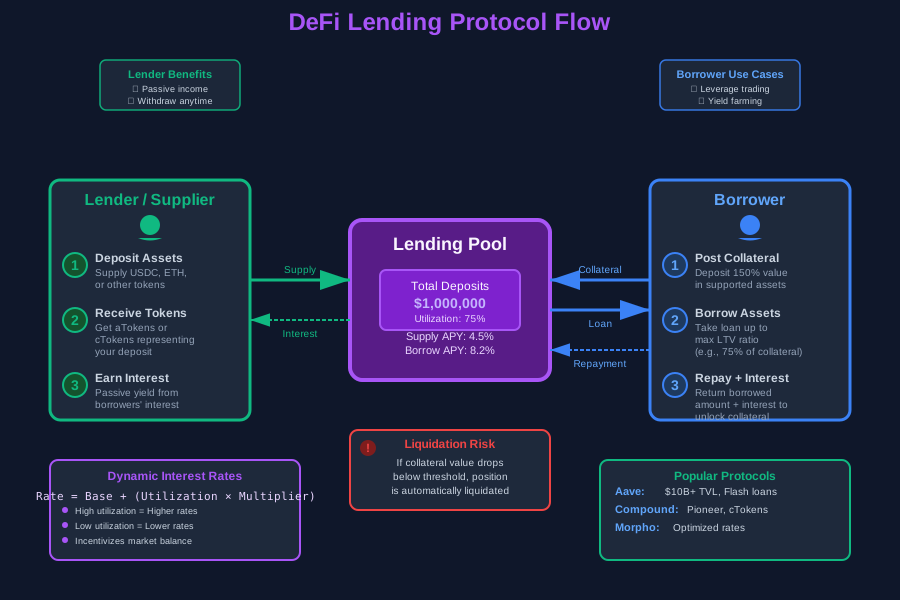
Users deposit assets into lending pools and receive interest-bearing tokens representing their deposit.
Borrowers deposit collateral and can take out loans up to a certain percentage of their collateral value.
Interest rates adjust algorithmically based on supply and demand - high utilization increases rates to attract more lenders.
If collateral value falls below the required threshold, positions are automatically liquidated to protect lenders.
Most lending protocols use utilization-based interest rate models:
Leading lending protocol with multiple asset markets and innovative features like rate switching and flash loans.
One of the earliest automated lending platforms with a straightforward design and governance token.
Pioneering lending platform focused on DAI stablecoin issuance against various collateral types.
Undercollateralized lending platform for institutional borrowers with delegate-managed lending pools.
Liquid staking derivatives have created a $40B ecosystem with sophisticated restaking mechanisms. EigenLayer's $15B TVL demonstrates demand for shared cryptoeconomic security, while LRTs enable users to earn both ETH staking rewards and additional validation service yields.
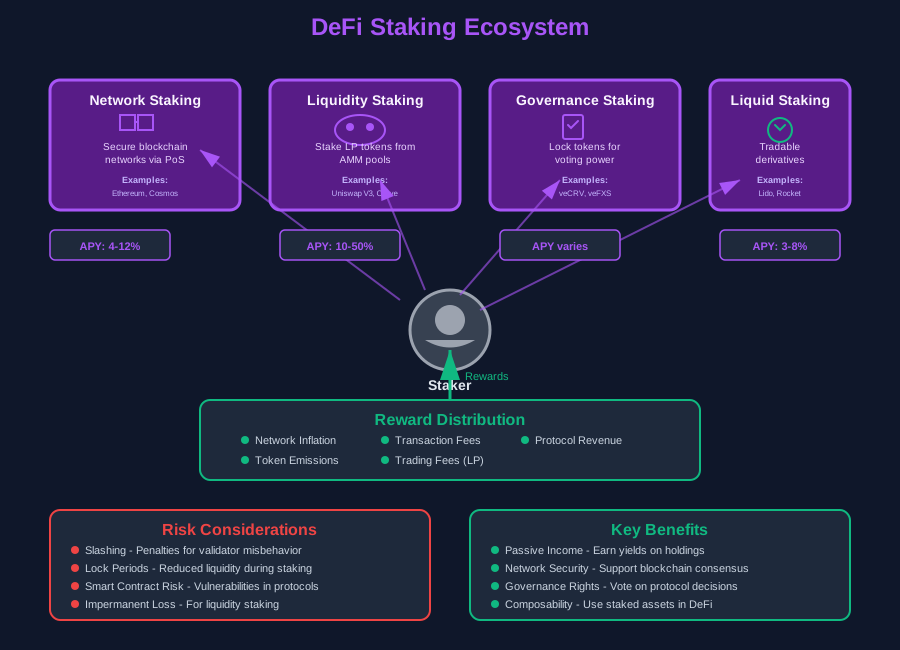
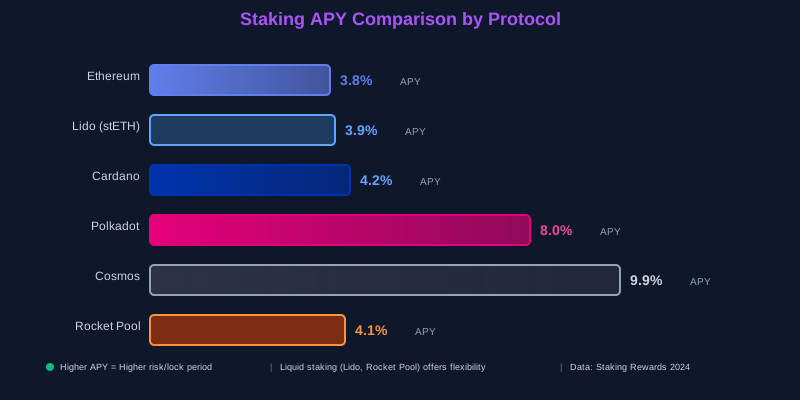
Securing Proof-of-Stake networks by locking up the network's native token. Validators are selected to produce blocks and verify transactions based on their stake.
Examples: Ethereum 2.0, Cosmos, Polkadot, Solana
Providing liquidity to AMM pools and staking the LP tokens to earn additional rewards beyond trading fees.
Examples: Uniswap V3 staking, SushiSwap Farms, Curve Gauges
Locking tokens to participate in protocol governance, with longer lock periods often resulting in greater voting power.
Examples: Curve veCRV, Frax veFXS, Balancer veBAL
Receiving tradable tokens representing staked assets, maintaining liquidity while earning staking rewards.
Examples: Lido, Rocket Pool, Ankr, StaFi
Staking has become one of the core yield generation mechanisms in DeFi, allowing users to put their assets to work while supporting network security and protocol operations.
Staking rewards come from various sources: network inflation, transaction fees, protocol revenue sharing, or token emissions.
Staking often involves lock-up periods. Longer commitments typically offer higher returns but reduce liquidity.
Staking carries risks like slashing (penalties for validator misbehavior), smart contract vulnerabilities, and impermanent loss in liquidity staking.
Annual Percentage Rate (APR) vs. Annual Percentage Yield (APY) - the latter compounds returns while the former doesn't.
Liquid staking has transformed the staking landscape by allowing users to maintain liquidity while earning staking rewards. Protocols like Lido issue derivative tokens (stETH, bETH) that represent staked assets.
These tokens can be used throughout DeFi - as collateral for loans, in AMM pools, or for further yield strategies - creating a powerful composability effect.
Liquid staking has spawned an entire ecosystem of staking derivative tokens and strategies:
A key challenge in the staking ecosystem is centralization risk. For example, Lido controls over 30% of all staked ETH, raising concerns about network security and censorship resistance.
Solutions being developed include:
Connecting different blockchain ecosystems to enable cross-chain interactions
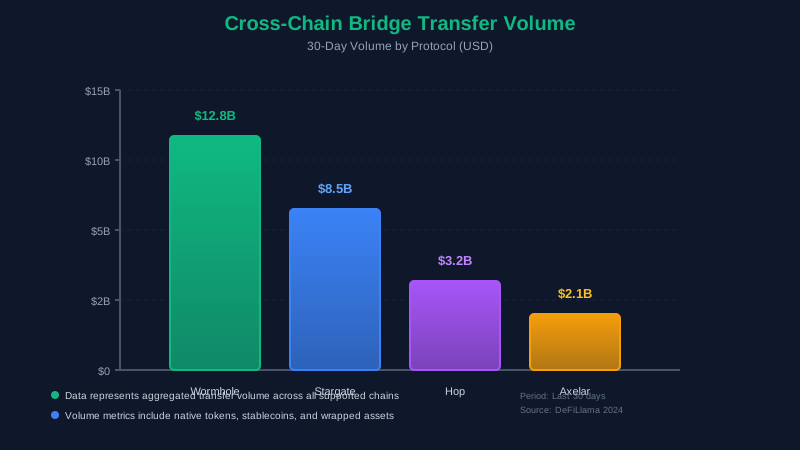
Bridge security has fundamentally evolved following $2.8B in historical losses. Zero-knowledge bridges like zkBridge eliminate external trust assumptions through cryptographic proofs, reducing verification costs from ~80M gas to ~227K gas - a 99.7% efficiency improvement.
Operated by a central entity or federation that verifies and processes cross-chain transfers. Simpler but requires trust in the operators.
Examples: Binance Bridge, WBTC (Wrapped Bitcoin)
Operate without centralized control, using smart contracts, cryptographic proofs, or consensus mechanisms to ensure security.
Examples: Hop Protocol, Connext, Across Protocol
Assume transfers are valid unless challenged within a dispute period, similar to optimistic rollups. Balance security with efficiency.
Examples: Nomad (before exploit), Rainbow Bridge
Use light clients (simplified blockchain validators) to verify transactions from the source chain on the destination chain.
Examples: Near Rainbow Bridge, LayerZero
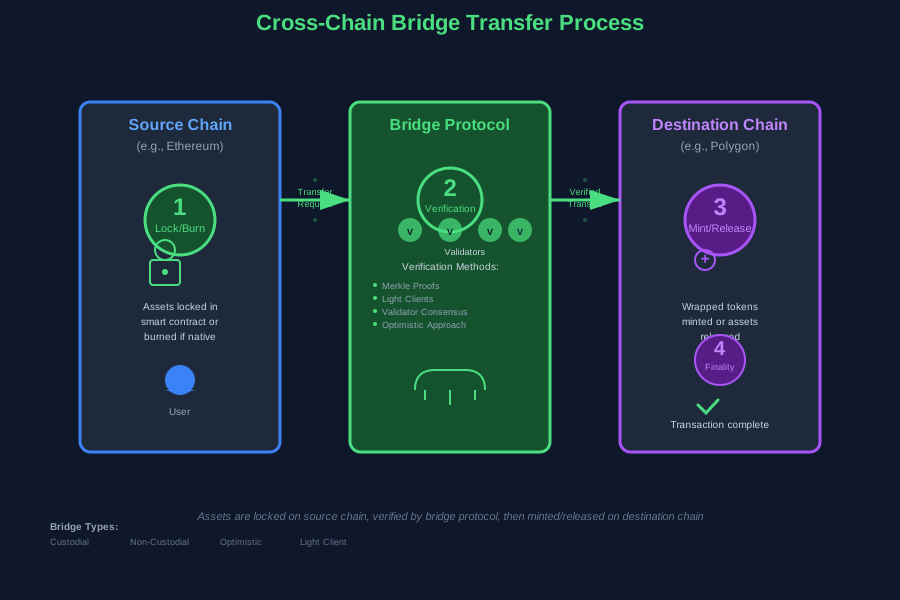
Bridge protocols facilitate the secure transfer of assets between different blockchain networks through a structured process:
Assets are locked in a smart contract on the source chain or burned if they're native to that chain.
The bridge protocol verifies that the assets have been locked or burned using various mechanisms (relayers, validators, merkle proofs).
Equivalent assets are minted on the destination chain (as wrapped tokens) or released from a locked position.
Transaction is completed, and the user receives their assets on the destination chain. The time this takes depends on the bridge design and security model.
A set of trusted validators verify cross-chain transactions and sign messages confirming their validity.
Uses cryptographic hash locks and time locks to secure asset transfers across chains.
Uses liquidity pools on both chains to enable quick transfers without actual asset movement across chains.
Uses cryptographic proofs to verify that events occurred on the source chain.
Blockchain interoperability goes beyond simple asset transfers. Interoperability frameworks aim to create standardized ways for different blockchains to communicate and share both assets and information.
The Inter-Blockchain Communication protocol allows different blockchains in the Cosmos ecosystem to transfer tokens and data. Chains connect to each other directly rather than through a central hub.
Cross-Chain Message Passing enables parachains (individual blockchains) in the Polkadot ecosystem to communicate through the central Relay Chain.
An omnichain interoperability protocol that enables cross-chain messaging with configurable security. Uses a combination of on-chain light clients and off-chain oracles.
A decentralized network that connects blockchain ecosystems, applications, and users. Uses secure cross-chain communication to enable asset transfers and general messaging.
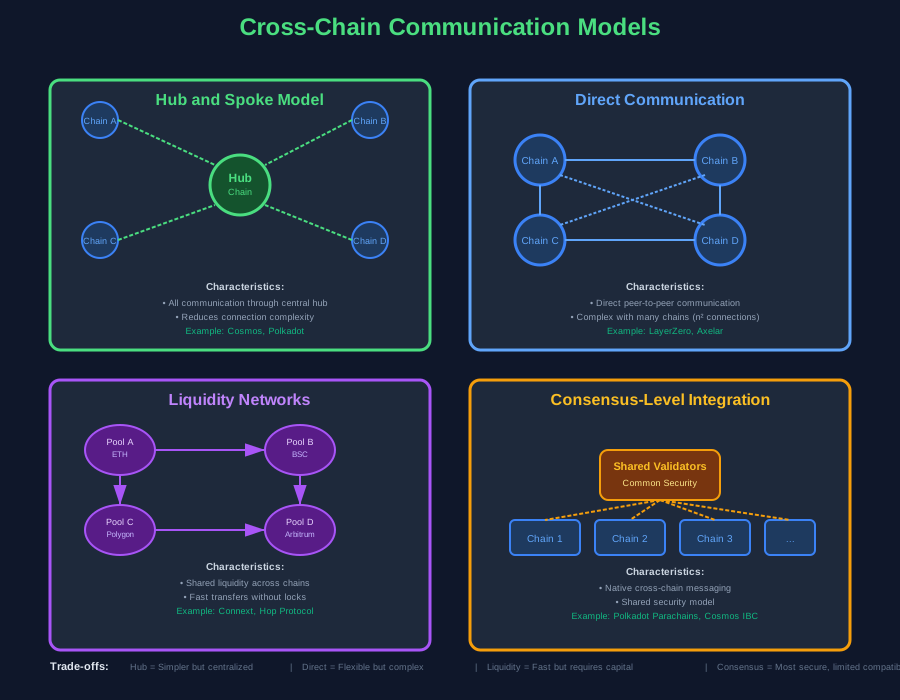
A central chain (hub) connects to multiple other chains (spokes), facilitating communication between them.
Chains establish direct channels of communication with each other as needed, without a central mediator.
Uses liquidity pools across chains to simulate asset transfers without directly moving assets between chains.
Integration of cross-chain functionality at the consensus protocol level, enabling native interoperability.
Standardization efforts are crucial for effective interoperability. Several initiatives aim to create common protocols for cross-chain communication:
Cross-chain systems face unique security challenges:
The next generation of DeFi applications will be natively multi-chain, using cross-chain infrastructure to:
Cross-chain liquidity refers to the ability to access and use capital across different blockchains efficiently. As DeFi expands across multiple chains, solutions for managing liquidity across these networks become increasingly important.
Direct peer-to-peer exchanges of tokens across different blockchains using hash-time locked contracts.
Examples: Lightning Network's cross-chain swaps
Networks of liquidity pools across multiple chains that facilitate asset transfers without direct blockchain-to-blockchain transfers.
Examples: Hop Protocol, Thorchain, Connext
Creation of synthetic versions of assets from other chains, allowing exposure without actually transferring the underlying asset.
Examples: Synthetix, Mirror Protocol
Tokenized representations of assets from other chains, backed 1:1 by the original asset locked in a bridge contract or custodian.
Examples: WBTC on Ethereum, WETH on Solana
THORChain is a decentralized liquidity network that enables cross-chain swaps without wrapped tokens or centralized bridges.
Key features:
Hop is a scalable rollup-to-rollup general token bridge, allowing users to move tokens between L2s and sidechains.
Key features:
Cross-chain DeFi faces major challenges in maintaining the composability that made Ethereum DeFi so powerful.
Current challenges include:
Standardization
Common protocols for cross-chain messaging and asset transfers will improve interoperability and security.
ZK-Proofs
Zero-knowledge proofs will enable more secure, efficient cross-chain verification without relying on trusted third parties.
Cross-Chain DAOs
Governance systems that operate across multiple chains will coordinate liquidity and protocol parameters ecosystem-wide.
The interfaces and tools that allow users to interact with DeFi protocols
Account abstraction has achieved significant scale with 1.9+ million deployed wallets and 8.5+ million transactions. ERC-4337's UserOperation system enables gasless transactions, social recovery, and custom authentication methods, reaching Web2 parity in user experience.
Connected to the internet, offering convenience but with higher security risks. Includes browser extensions, mobile apps, and web wallets.
Examples: MetaMask, Trust Wallet, Rainbow
Offline storage solutions that provide enhanced security by keeping private keys offline. Includes hardware wallets and paper wallets.
Examples: Ledger, Trezor, GridPlus
Wallet accounts controlled by smart contracts rather than private keys, enabling advanced features like social recovery, batched transactions, and programmable security.
Examples: Safe (formerly Gnosis Safe), Argent, Loopring
Multi-Party Computation wallets split private keys across multiple parties, requiring consensus for transactions while maintaining security.
Examples: Zengo, Fireblocks
Wallet technologies are evolving to improve security, usability, and functionality. These interfaces serve as the crucial connection between users and the decentralized financial ecosystem.
Wallets generate or import a private key, used to derive a public key and address. The private key must remain secure.
When users initiate a transaction, the wallet formats it according to the blockchain's requirements, including recipient, amount, and fees.
The wallet uses the private key to cryptographically sign the transaction, proving the owner authorized it without revealing the key.
The signed transaction is sent to the blockchain network through a node, where it's verified, included in a block, and executed.
Allows direct interaction with decentralized applications from within the wallet interface.
Automatically detects and displays tokens held by the wallet address across multiple chains.
Provides estimates of transaction fees and allows customization for speed and cost preferences.
Manages assets across different blockchains from a single interface, simplifying cross-chain DeFi.
Previews transaction outcomes before submission, preventing errors and unexpected results.
Scans for potential scams, phishing attempts, and suspicious smart contracts before transactions.
Decentralized applications (dApps) are the software interfaces that allow users to interact with blockchain protocols. These applications run on decentralized networks rather than centralized servers, providing greater transparency, censorship resistance, and user control.
User interfaces built with standard web technologies (HTML, CSS, JavaScript) that connect to blockchain networks through wallet integrations and Web3 libraries.
Technologies: React, Vue.js, web3.js, ethers.js
The backend logic that runs on blockchain networks, handling transactions, storing state, and enforcing rules of the application.
Technologies: Solidity, Rust, Vyper
Services that index blockchain data to make it efficiently queryable by the frontend, enabling responsive user experiences.
Technologies: The Graph, Alchemy, Moralis
Distributed systems for storing application data and media that would be inefficient to store directly on the blockchain.
Technologies: IPFS, Arweave, Filecoin
User interfaces for decentralized exchanges, allowing users to swap tokens, provide liquidity, and manage positions.
Examples: Uniswap App, 1inch, dYdX
Interfaces for borrowing and lending crypto assets, monitoring positions, and managing collateral.
Examples: Aave Interface, Compound, Maker
Tools for monitoring DeFi investments, tracking yields, and analyzing performance across multiple protocols.
Examples: DeBank, Zapper, Zerion
Interfaces for participating in DAO governance, voting on proposals, and monitoring protocol metrics.
Examples: Snapshot, Tally, Boardroom
Developing DeFi applications comes with unique challenges:
Standards and patterns for improved dApp development:
A growing trend is the rise of aggregators that combine functionality from multiple protocols:
User experience (UX) is critical for the mainstream adoption of DeFi. The industry faces significant challenges in balancing decentralization with usability, security with convenience, and technical complexity with intuitive interfaces.
Complex concepts like gas fees, wallet security, and protocol mechanisms require significant user education compared to traditional finance.
Waiting for confirmations, managing gas costs, and handling transaction failures create friction that doesn't exist in centralized alternatives.
Using multiple blockchain networks requires understanding different token standards, bridge mechanisms, and managing multiple wallets.
Self-custody requires managing recovery phrases and private keys, creating a delicate balance between security and convenience.
Enables smart contract wallets with features like social recovery, gasless transactions, and batch operations, simplifying user experience.
Solutions like meta-transactions, gas stations, and EIP-1559 make gas fees more predictable and potentially invisible to end users.
Focus on mobile experiences with simplified interfaces and progressive disclosure of complex options based on user expertise.
Automation and bundling complex multi-step DeFi operations into single transactions with clear outcomes.
Simplified Security
Better security models that don't sacrifice user experience, including social recovery, MPC-based approaches, and user-friendly key management.
Unified Interfaces
Cross-chain dashboards that unify the fragmented ecosystem, giving users single interfaces to manage assets across multiple networks.
Embedded DeFi
Integration of DeFi capabilities into everyday applications, making blockchain interactions invisible to end users while preserving benefits.
Despite improvements, 2024 recorded $1.4B in losses across 303 incidents. However, defense-in-depth architectures with enhanced multi-signature systems and real-time anomaly detection have dramatically reduced successful exploit frequency.
Comprehensive code reviews by security experts to identify vulnerabilities before deployment, preventing potential exploits.
Require multiple approvals for transactions, reducing single points of failure and unauthorized access risks.
Incentivize security researchers to find and report vulnerabilities before malicious actors can exploit them.
Leading with $190M capital pool and $194M active coverage. Despite expansion, only 2% of DeFi TVL currently maintains insurance coverage, representing significant growth opportunity.
Smart contracts automate claim processing and payouts, eliminating intermediaries and reducing insurance costs.
Distributed risk across multiple participants, currently covering less than 1% of total DeFi TVL but growing rapidly.
Enterprise Ethereum Alliance's standardized risk assessment frameworks for DeFi protocols, version 2 expected in 2025.
Tools like Chainalysis, Nansen, and Dune Analytics provide comprehensive DeFi risk tracking and assessment capabilities.
Systematic identification of smart contract bugs, liquidity crises, flash loan attacks, and governance exploits.
Code vulnerabilities that can be exploited to drain funds or manipulate protocol behavior.
Insufficient liquidity leading to large price slippage or inability to execute trades.
Malicious proposals or token concentration that can compromise protocol governance.
Exploitation of price manipulation using large, uncollateralized loans within a single transaction.
Blockchain analytics and compliance
On-chain analytics and insights
Community-driven blockchain data
Smart contract architecture evaluation
Liquidity and volatility analysis
Governance and team evaluation
Aave has evolved from a simple lending platform to a comprehensive DeFi protocol with over $5 billion in total value locked across multiple blockchains.
The protocol pioneered innovations such as flash loans, interest-bearing aTokens, and cross-chain lending markets, setting standards for the entire DeFi lending space.
Governance has successfully transitioned to a fully decentralized model through the Aave DAO, demonstrating how large-scale DeFi protocols can operate without centralized control.
Uniswap revolutionized decentralized trading with its automated market maker model, growing to facilitate billions in daily trading volume across thousands of token pairs.
Through multiple iterations (V1, V2, V3), Uniswap has improved capital efficiency, added features, and expanded to multiple blockchains while maintaining a focus on decentralization.
The Uniswap UX has raised the bar for DeFi interfaces, making complex trading accessible to mainstream users while preserving the benefits of decentralization.
At its peak, the DeFi ecosystem locked over $250 billion in assets across protocols, demonstrating significant capital absorption.
Despite market volatility, core DeFi protocols have maintained substantial TVL, showing resilience through multiple market cycles.
The number of unique addresses interacting with DeFi protocols has grown from thousands in 2020 to millions in 2023, with accelerating adoption curves.
Geographic distribution shows global adoption, with particularly strong growth in regions with unstable currencies or limited traditional banking access.
The DeFi space continuously introduces new financial primitives at a pace far exceeding traditional finance, with rapid iteration cycles driving improvement.
Open-source collaboration has created a vibrant ecosystem where innovations are quickly adopted, improved, and composably integrated.
One of the earliest major DeFi hacks resulted in the loss of ~3.6 million ETH from a decentralized investment fund, leading to the Ethereum hard fork.
Lesson: Smart contract security requires rigorous auditing, formal verification, and conservative deployment strategies.
Cross-chain bridges have proven to be particularly vulnerable points, with exploits like Ronin Network ($625M), Wormhole ($320M), and Nomad ($190M).
Lesson: Cross-chain infrastructure requires extra security attention and progressive scaling of value locked.
The Terra/Luna collapse and the subsequent contagion effect demonstrated the interconnected risks in the ecosystem.
Lesson: Algorithmic stability mechanisms require extreme stress testing, and dependencies between protocols create systemic risk.
The industry has matured in its approach to smart contract development, with established best practices, security tools, and formal verification methods.
Decentralized governance has shown surprising effectiveness at responding to crises, implementing upgrades, and managing community interests.
Newer protocols incorporate explicit risk management features from the start, learning from previous failures in the ecosystem.
The ecosystem is evolving toward specialized protocols that excel at specific functions, replacing earlier monolithic designs.
Traditional financial institutions are increasingly engaging with DeFi through:
Tokenization of traditional assets is bringing real-world value on-chain:
Evolving regulatory approaches are creating pathways for compliant DeFi:
MakerDAO, the protocol behind the DAI stablecoin, has begun allocating substantial treasury resources to real-world assets:
This shift represents a broader trend of DeFi protocols bridging the gap between on-chain and traditional finance, creating hybrid models that combine the best of both worlds.
zkEVMs collectively exceed $1B TVL with Polygon zkEVM growing 240% year-over-year. Ethereum Foundation targets 10-second latency by 2025 for mainstream blockchain integration.
Examples: Polygon zkEVM, zkSync Era, StarkNet
Separating blockchain functions (consensus, execution, data availability, settlement) enables specialized optimization and greater scalability.
Examples: Celestia, Fuel, Sui
Ecosystems where multiple chains share security from a parent chain or validator set, enabling secure specialized execution environments.
Examples: Polkadot parachains, Cosmos ICS
Purpose-built execution environments stacked on top of scaling layers, providing further optimization for specific applications.
Examples: Application-specific rollups, validiums
ZK proofs are enabling private financial transactions while maintaining verifiability, addressing a key limitation of transparent blockchains.
Protocols that maintain confidentiality for sensitive financial information while enabling compliance and transparent audit trails.
Systems allowing users to prove specific attributes (like creditworthiness) without revealing underlying data, enabling reputation-based finance.
Moving beyond direct contract interactions to systems where users express financial goals, and protocols optimize execution paths across the DeFi ecosystem.
Examples: Intents protocols, Automated Portfolio Management
RWA tokenization has reached $118B market value with Centrifuge financing $661M+ in assets. MakerDAO's $1B Treasury allocation and BlackRock's BUIDL fund demonstrate institutional DeFi-TradFi convergence.
Examples: Tokenized U.S. Treasuries, corporate bonds, real estate
Self-governing, AI-enhanced financial entities that operate independently, managing assets and providing services without human intervention.
Examples: Advanced DAOs, algorithmic asset managers
Financial systems designed to fund public goods, environmental restoration, and sustainable development through innovative cryptoeconomic mechanisms.
Examples: Carbon credits, impact certificates, ecological tokens
EU's MiCA implementation creates comprehensive standards for crypto-asset service providers, with fully decentralized protocols remaining exempt under Recital 22, preserving innovation space.
27% of institutional investors now participate in DeFi, with family offices leading at 25% allocation. Bitcoin ETFs achieved $108B AUM, demonstrating institutional demand when regulatory uncertainty diminishes.
Blockchain networks becoming the foundation for global value transfer, with traditional financial systems connecting through standardized interfaces.
DeFi has the potential to revolutionize access to financial services:
Broader economic implications of mature DeFi systems:
Key hurdles to overcome for DeFi's future:
The end goal of DeFi development is not simply to recreate traditional finance on blockchains, but to build an entirely new financial system with:
This vision represents a fundamental redesign of our financial infrastructure, requiring collaborative efforts across technical, regulatory, and educational domains.